On my walk today, I listened to a downloaded interview from the On Being website. The interview was with ‘vocal magician and conductor’ Bobby McFerrin, and something he said early on in the interview really caught my attention.
Articles
What is neurogenesis?
Neurogenesis — the creation of new brain cells — occurs of course at a great rate in the very young. For a long time, it was not thought to occur in adult brains — once you were grown, it was thought, all you could do was watch your brain cells die!
Adult neurogenesis (the creation of new brain cells in adult brains) was first discovered in 1965, but only recently has it been accepted as a general phenomenon that occurs in many species, including humans (1998).
Prevalence
Vascular dementia, as its name suggests, is caused by poor blood flow, produced by a single, localized stroke, or series of strokes.
It is the second most common dementia, accounting for perhaps 17% of dementias. It also co-occurs with Alzheimer's in 25-45% of cases. Although there are other types of dementia that also co-occur with Alzheimer's, mixed dementia generally refers to the co-occurrence of Alzheimer's and vascular dementia.
There was an alarming article recently in the Guardian newspaper. It said that in the UK, diabetes is now nearly four times as common as all forms of cancer combined. Some 3.6 million people in the UK are thought to have type 2 diabetes (2.8 are diagnosed, but there’s thought to be a large number undiagnosed) and nearly twice as many people are at high risk of developing it. The bit that really stunned me? Diabetes costs the health service roughly 10% of its entire budget.
Autobiographical memory contains the information you have about yourself. It includes several domains:
Recently a “Framework for Success in Postsecondary Writing” came out in the U.S. This framework talked about the importance of inculcating certain “habits of mind” in students. One of these eight habits was metacognition, which they defined as the ability to reflect on one’s own thinking as well as on the individual and cultural processes used to structure knowledge.
Montessori education
Maria Montessori (1870-1952) was an Italian physician. After working with retarded children in a psychiatric clinic attached to the University of Rome, she applied the ideas she had developed to children in a slum district in Rome. This was the first Casa dei Bambini ("children's house"). It opened in 1907. Two years later she set out her methods and principles in a book, which was translated as The Montessori Method in 1912.
Find out about the pegword mnemonic
Here are pegwords I've thought up in the Spanish language.
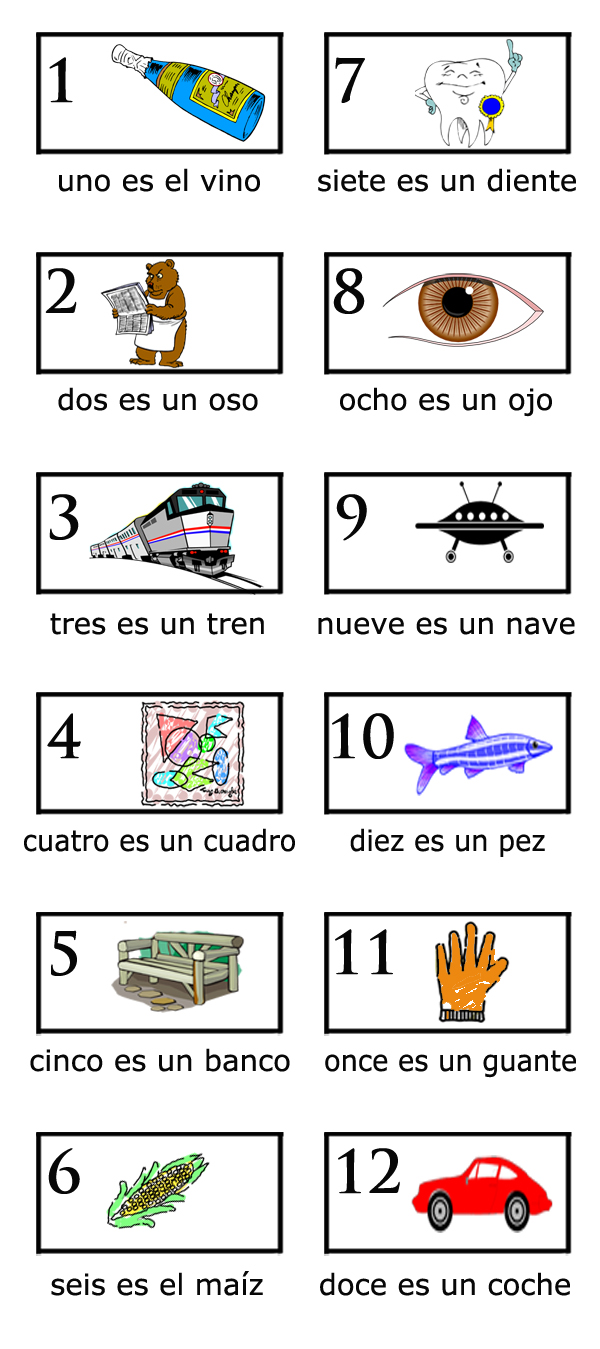
As with the original example, let's try it out with our cranial nerves.
En español, los nervios craneales son:
What mnemonics are, and what they are for
Aids to memory such as acronyms, rhymes, linking information by creating visual images or making up a story, are called mnemonics. Mnemonic strategies have been recommended as appropriate for remembering the following types of information:
How many words do you need to learn?
An analysis of English vocabulary* has found that the first 1000 words account for 84.3% of the words used in conversation, 82.3% of the words encountered in fiction, 75.6% of the words in newspapers, and 73.5% of the words in academic texts. The second 1000 accounts for about another 5% (specifically, 6% of conversation, 5.1% of fiction, 4.7% of newspapers, 4.6% of academic texts).