Forget the persistent myth that everything is remembered; that our brains are video cameras whirring away recording everything, and that such 'hidden' knowledge can be brought to light by a hypnotist or alien artefact. Such things are the stuff of fantasy. Of course, there is a nugget of truth there: we can, and do, remember things we've paid no conscious attention to. Sometimes the right question can elicit memories we didn't know we had, in more detail than we imagined we could have. But for the most part, what's not noticed is not remembered. Attention is crucial to memory.
Articles
Remembering a skill is entirely different from remembering other kinds of knowledge. It’s the difference between knowing how and knowing that.
What is neurogenesis?
Neurogenesis — the creation of new brain cells — occurs of course at a great rate in the very young. For a long time, it was not thought to occur in adult brains — once you were grown, it was thought, all you could do was watch your brain cells die!
Adult neurogenesis (the creation of new brain cells in adult brains) was first discovered in 1965, but only recently has it been accepted as a general phenomenon that occurs in many species, including humans (1998).
Brain autopsies have revealed that a significant number of people die with Alzheimer’s disease evident in their brain, although in life their cognition wasn’t obviously impaired. From this, the idea of a “cognitive reserve” has arisen — the idea that brains with a higher level of neuroplasticity can continue to work apparently normally in the presence of (sometimes quite extensive) brain damage.
What is a tip-of-the-tongue experience?
The tip-of-the-tongue experience (TOT) is characterized by being able to retrieve quite a lot of information about the target word without being able to retrieve the word itself. You know the meaning of the word. You may know how many syllables the word has, or its initial sound or letter. But you can’t retrieve it all. The experience is coupled with a strong feeling (this is the frustrating part) that you know the word, and that it is hovering on the edges of your thought.
Let's look a little deeper into the value of mnemonics for knowledge acquisition. By “knowledge acquisition”, I mean the sort of information you learn from textbooks — information that is not personal, that you need for the long-term.
In this context, I believe the chief value of mnemonic strategies is to help you recall information that needs to be remembered in a particular order. Thus we use mnemonics to help us remember the order of the planets, the order of musical notes on the stave, the order of the colors in a rainbow.
Find out about the pegword mnemonic
Here are pegwords I've thought up in the Spanish language.
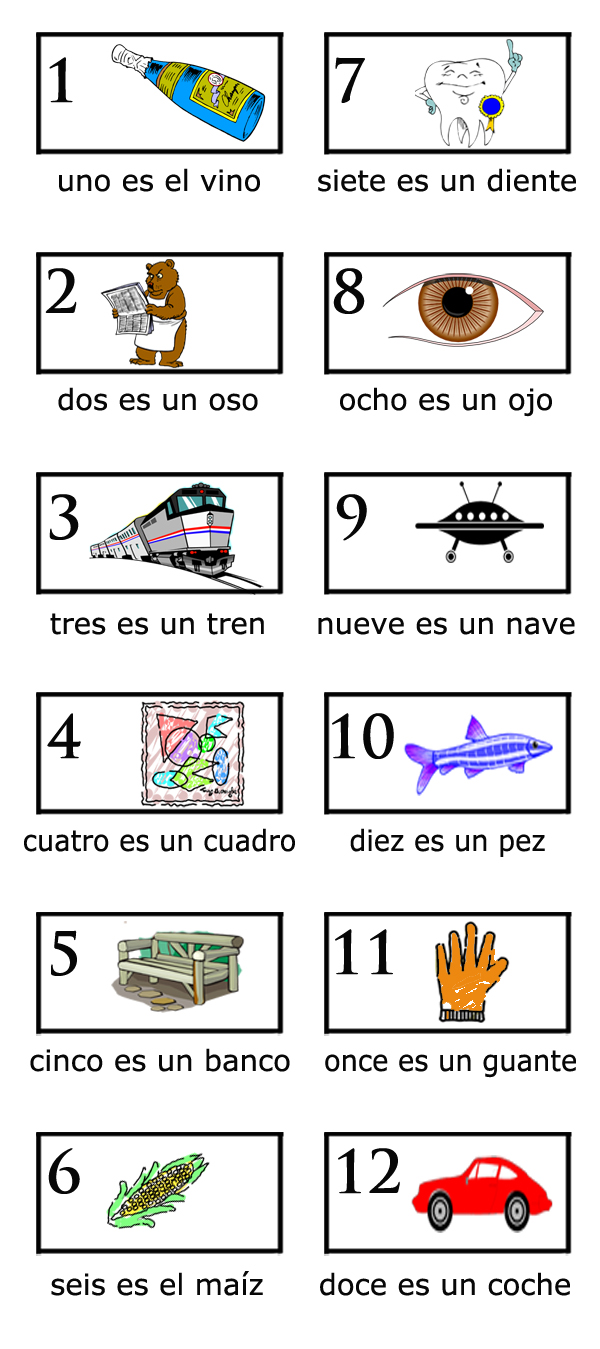
As with the original example, let's try it out with our cranial nerves.
En español, los nervios craneales son:
The more hyped and less plausible passive Mozart Effect
The so-called "Mozart effect" refers to two quite different phenomena. The one that has received the most media play concerns the almost magical (and mythical) effect of Mozart's music on intelligence. It is the result of a misrepresentation of the research results. Rauscher, Shaw, and Ky's 1993 study found that 10 minutes of exposure to Mozart's Sonata for Two Pianos in D Major K. 448 temporarily enhanced performance on three spatial reasoning tasks.
Introduction
In 1997, the U.S. Congress asked the Director of the National Institute of Child Health and Human Development (NICHD) at the National Institutes of Health, in consultation with the Secretary of Education, to convene a national panel to assess the effectiveness of different approaches used to teach children to read. For over two years, the National Reading Panel reviewed research-based knowledge on reading instruction and held open panel meetings in Washington, DC, and regional meetings across the United States.
Most people find numbers — phone numbers, personal identification numbers, dates, and so on — more difficult to remember than words. That is, of course, why businesses try to get phone numbers that correspond to some relevant word. The system whereby this is possible — the linking of certain letters to the different digits on a telephone calling pad —is a kind of coding mnemonic. Basically, coding mnemonics are systems that transform numbers into words.