Common everyday memory strategies
The most frequently used everyday memory strategies are:
The most frequently used everyday memory strategies are:
In a 1987 experiment (1), readers were presented with a text that included one or other of these sentences:
or
Both texts went on to say:
Dementia is estimated1 to afflict over 35.5 million people worldwide -- this includes nearly 10 million people in Europe, nearly 4.4 million in North America, nearly 7 million in South and Southeast Asia, about 5.5 million in China and East Asia and about 3 million in Latin America.
Find out about the pegword mnemonic
Here are pegwords I've thought up in the Spanish language.
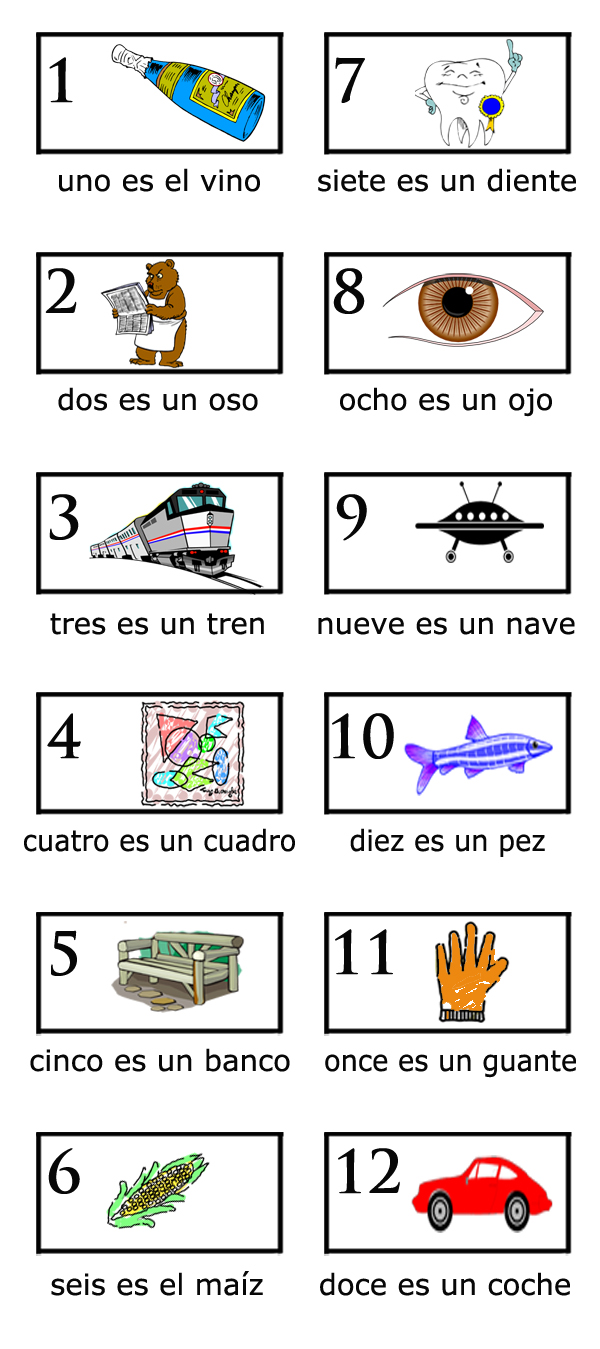
As with the original example, let's try it out with our cranial nerves.
En español, los nervios craneales son:
We all know that lack of sleep makes us more prone to attentional failures, more likely to make mistakes, makes new information harder to learn, old information harder to retrieve ... We all know that, right? And yet, so many of us still go to bed too late to get the sleep we need to function well. Of course, some of us go to sleep early enough, we just can’t get to sleep fast enough, or are prone to waking in the night. (Personally, I can count the times I’ve slept through the night without waking in the last fifteen years on my fingers).
Learning a new language is made considerably more difficult if that language is written in an unfamiliar script. For some, indeed, that proves too massive a hurdle, and they give up the attempt.
I’ve discussed on a number of occasions the effects that stereotypes can have on our cognitive performance. Women, when subtly reminded that females are supposedly worse at math, do more poorly on math tests; African-Americans, when subtly reminded of racial stereotypes, perform more poorly on academic tests. And beliefs about the effect of aging similarly affect memory and cognition in older adults.
Maria Montessori (1870-1952) was an Italian physician. After working with retarded children in a psychiatric clinic attached to the University of Rome, she applied the ideas she had developed to children in a slum district in Rome. This was the first Casa dei Bambini ("children's house"). It opened in 1907. Two years later she set out her methods and principles in a book, which was translated as The Montessori Method in 1912.
Around the world, for the most part, compulsory schooling starts at 6, although some start at 7, and a very few at 5 or even younger. There is less consensus about how long compulsory education should last, but 9 years is the most common length, with 10 years running a close second.
I have previously reported on how gait and balance problems have been associated with white matter lesions, and walking speed and grip strength have been associated with dementia and stroke risk.