Michael Gove is reported as saying that ‘Learning facts by rote should be a central part of the school experience’, a philosophy which apparently underpins his shakeup of school exams. Arguing that "memorisation is a necessary precondition of understanding", he believes that exams that require students to memorize quantities of material ‘promote motivation, solidify knowledge, and guarantee standards’.
Articles
The conventional view of brain development has been that most of this takes place in utero and in the first three years, with the further development continuing until the brain is fully mature at around 10-12 years of age. The turbulence of adolescent behavior has been deemed to be mostly caused by hormonal changes. Piaget, who identified four stages of cognitive development, assessed that his highest stage — that of formal, abstract reasoning — occurred around 13-14 years (although not everyone reaches this level, which requires appropriate education).
Forget the persistent myth that everything is remembered; that our brains are video cameras whirring away recording everything, and that such 'hidden' knowledge can be brought to light by a hypnotist or alien artefact. Such things are the stuff of fantasy. Of course, there is a nugget of truth there: we can, and do, remember things we've paid no conscious attention to. Sometimes the right question can elicit memories we didn't know we had, in more detail than we imagined we could have. But for the most part, what's not noticed is not remembered. Attention is crucial to memory.
Brain tissue is divided into two types: gray matter and white matter. These names derive very simply from their appearance to the naked eye. Gray matter is made up of the cell bodies of nerve cells. White matter is made up of the long filaments that extend from the cell bodies - the "telephone wires" of the neuronal network, transmitting the electrical signals that carry the messages between neurons.
The volume of gray matter tissue - a measure you will see cited in various reports - is a measure of the density of brain cells in a particular region.
The two types of first-letter mnemonics
First-letter mnemonics are, as their name suggests, memory strategies that use the initial letters of words as aids to remembering. This can be an effective technique because initial letters are helpful retrieval cues, as anyone who has endeavored to remember something by mentally running through the letters of the alphabet can attest to.
There are two types of first-letter mnemonic:
To use a strategy effectively, you need to understand why it works, how it works, when it works and when it doesn’t.
For example, all students take notes — not everyone knows how to do it well. Research into the effectiveness of note-taking has found — surprise, surprise — that sometimes note-taking helps you remember information, and sometimes it doesn’t1.
The other day I was sitting in the sunshine in my living room going through some journal articles I'd photocopied. I realized I needed to staple the pages together and went down to my study to get the stapler. Approaching my desk, I decided to check my email while I was there. And then, I decided to check my library account online to see whether a book I had requested had turned up. When I'd done that, I went back upstairs to my papers. Where I realized, of course, that I'd forgotten the stapler.
We all like simple solutions. However much we may believe we are ‘above’ black-&-white dichotomies, that of course we understand that every situation is complex, nevertheless we have a brain that can only think of a very very few things at once. So it's unsurprising that we are drawn to solutions that can be summed up simply, that can fit comfortably within the limitations of working memory.
What is a tip-of-the-tongue experience?
The tip-of-the-tongue experience (TOT) is characterized by being able to retrieve quite a lot of information about the target word without being able to retrieve the word itself. You know the meaning of the word. You may know how many syllables the word has, or its initial sound or letter. But you can’t retrieve it all. The experience is coupled with a strong feeling (this is the frustrating part) that you know the word, and that it is hovering on the edges of your thought.
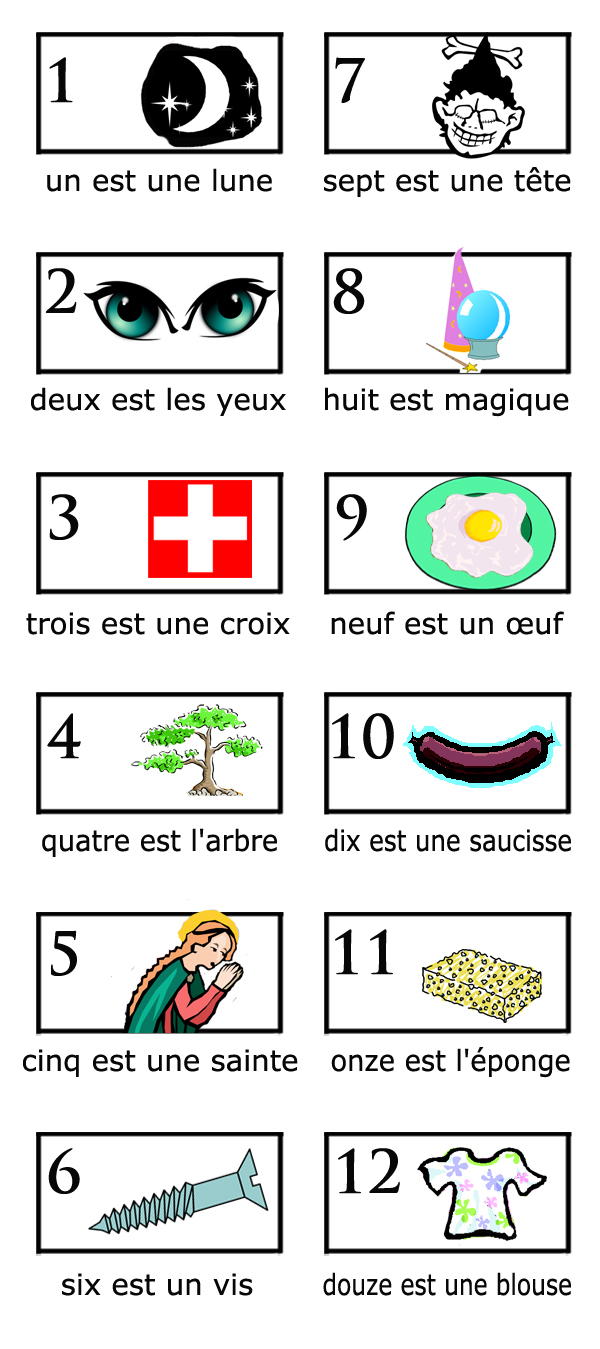
Find out about the pegword mnemonic
Here are pegwords I've thought up in the French language.
As with the original example, let's try it out with our cranial nerves.
En francais, les nerfs crâniens son: