Because it holds some personal resonance for me, my recent round-up of genetic news called to mind food allergies. Now food allergies can be tricky beasts to diagnose, and the reason is, they’re interactive. Maybe you can eat a food one day and everything’s fine; another day, you break out in hives. This is not simply a matter of the amount you have eaten, the situation is more complex than that.
Articles
Research; study; learning; solving problems; making decisions — all these, to be done effectively and efficiently, depend on asking the right questions. Much of the time, however, people let others frame the questions, not realizing how much this shapes how they think.
I’ve recently had a couple of thoughts about flow — that mental state when you lose all sense of time and whatever you’re doing (work, sport, art, whatever) seems to flow with almost magical ease. I’ve mentioned flow a couple of times more or less in passing, but today I want to have a deeper look, because learning (and perhaps especially that rewiring I was talking about in my last post) is most easily achieved if we can achieve "flow" (also known as being ‘in the zone’).
Let’s start with some background.
Find out about the pegword mnemonic
Here are pegwords I've thought up in the French language.
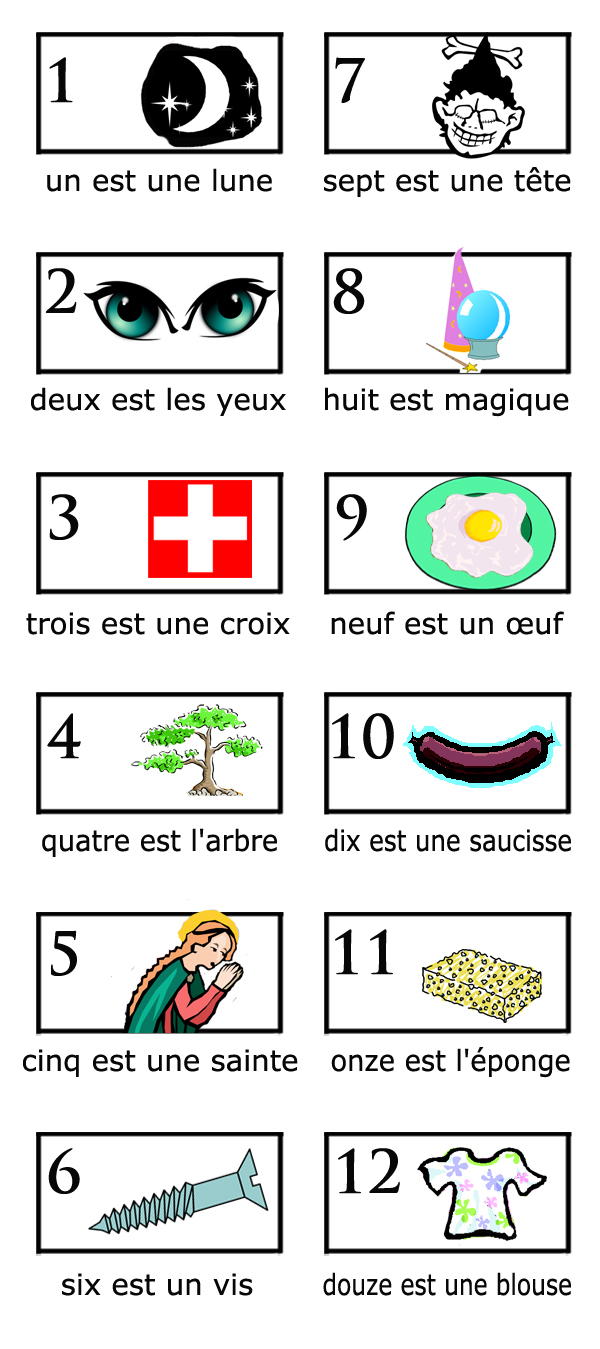
As with the original example, let's try it out with our cranial nerves.
En francais, les nerfs crâniens son:
Does emotion help us remember? That's not an easy question to answer, which is unsurprising when you consider the complexities of emotion.
First of all, there are two, quite different, elements to this question. The first concerns the emotional content of the information you want to remember. The second concerns the effect of your emotional state on your learning and remembering.
The effect of emotional content
It does seem clear that, as a general rule, we remember emotionally charged events better than boring ones.
I have spoken before, here on the website and in my books, about the importance of setting specific goals and articulating your specific needs. Improving your memory is not a single task, because memory is not a single thing. And as I have discussed when talking about the benefits of ‘brain games’ and ‘brain training’, which are so popular now, there is only a little evidence that we can achieve general across-the-board improvement in our cognitive abilities.
How many words do you need to learn?
An analysis of English vocabulary* has found that the first 1000 words account for 84.3% of the words used in conversation, 82.3% of the words encountered in fiction, 75.6% of the words in newspapers, and 73.5% of the words in academic texts. The second 1000 accounts for about another 5% (specifically, 6% of conversation, 5.1% of fiction, 4.7% of newspapers, 4.6% of academic texts).
People are poor at assessing their own memory
One thing research seems to show rather consistently is that, for older adults in particular, beliefs about one's own memory performance have little to do with one's actual memory performance¹. People who believe they have a poor memory are usually no worse at remembering than those who believe they have a good memory.
Human memory is a complex and varied phenomenon, and we could delve into its mysteries every day for a hundred years and still have plenty to talk about. But if I had to pick one factor that was absolutely crucial to the operation of memory, I would pick the deceptively simple concept of similarity. Similarity.
We all think we know what that means. An orange is similar to a mandarin; a zebra is similar to a horse; a cup is similar to a glass; my son is similar to his brother. A car is similar to an elephant.
??
One of my perennial themes is the importance of practice, and in the context of developing expertise, I have talked of ‘deliberate practice’ (a concept articulated by the well-known expertise researcher K. Anders Ericsson). A new paper in the journal Psychology of Music reports on an interesting study that shows how the attributes of music practice change as music students develop in expertise. Music is probably the most studied domain in expertise research, but I think we can gain some general insight from this analysis. Here’s a summary of the findings.